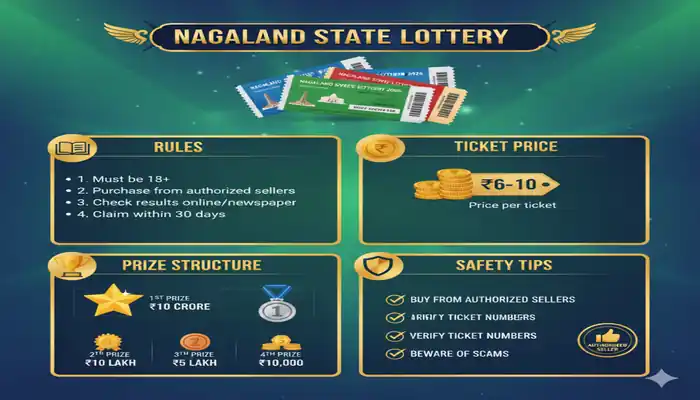
Nagaland State Lottery 2026 is one of the legally operated state-run lotteries in India. It is conducted under government supervision and is designed to function within a regulated framework. Unlike private or unauthorized lotteries, the Nagaland lottery operates under a defined legal structure established by Indian law.
If you are planning to purchase a ticket, it is essential to understand the rules, ticket pricing, prize structure, tax implications, and safety considerations. This guide provides clear, factual, and structured information without exaggeration.
Legal Framework and Background
Nagaland State Lottery operates under The Lotteries (Regulation) Act, 1998, which governs how state lotteries are conducted in India. Under this Act:
- Only state governments are permitted to conduct lotteries.
- Private lotteries are not legally allowed.
- Draw procedures must follow regulatory guidelines.
The lottery in Nagaland is supervised by the Directorate of Nagaland State Lotteries, which manages ticket issuance, draw processes, and prize disbursement.
Not all Indian states permit lotteries. Nagaland is among the states where state-run lotteries are legally authorized.
Ticket Price Structure in 2026
Ticket prices vary depending on the type of draw.
Regular Daily Draw Tickets
- Approximate price: ₹6 per ticket
- Multiple draws per day (commonly Morning, Day, and Evening formats)
Special / Bumper Draw Tickets
- Price range: ₹100 to ₹500
- Higher jackpot values
- Limited frequency (often during festivals or special events)
The minimum ticket price is regulated and cannot fall below prescribed government norms.
Prize Structure 2026
The prize structure is tier-based and varies slightly depending on the scheme. A typical structure includes:
| Prize Category | Approximate Amount |
|---|---|
| 1st Prize | Up to ₹1 Crore |
| 2nd Prize | ₹9,000 – ₹10,000 |
| 3rd Prize | ₹450 – ₹500 |
| 4th Prize | ₹250 |
| 5th Prize | ₹120 |
| Consolation Prize | Around ₹1,000 (scheme dependent) |
Bumper draws may offer jackpots ranging from ₹3–5 Crore.
It is important to understand that lottery outcomes are purely random, and the statistical probability of winning large prizes is low.
Draw Process
Nagaland State Lottery draws are conducted at pre-declared times:
- Multiple daily draws
- Fixed schedules
- Pre-announced ticket series
Each ticket includes:
- Unique serial number
- Series code
- Official printing details
Results are published through authorized channels after completion of the draw process.
Tax on Lottery Winnings in 2026
Lottery winnings in India are subject to taxation under income tax laws.
Key points:
- 30% flat TDS (Tax Deducted at Source) on winnings above ₹10,000
- Additional surcharge and cess may apply
- No deductions or exemptions allowed on lottery income
For example, if a winner receives ₹1 Crore, approximately ₹30 lakh or more may be deducted as tax before payout.
Lottery winnings must also be declared while filing income tax returns.
Prize Claim Process
For Small Prizes
- Can be claimed directly from authorized retailers
For Large Prizes
- Original ticket must be intact
- Valid government ID proof required
- Claim form submission
- Bank account details
- Passport-size photographs
Claims must usually be filed within the specified deadline (commonly within 30 days). Lost tickets are generally not eligible for claims.
Safety Tips to Avoid Lottery Scams
Lottery-related frauds are common. Follow these precautions:
- Purchase tickets only from licensed sellers.
- Avoid websites promising guaranteed wins.
- Never pay “processing fees” to unknown callers.
- Do not share OTPs, PINs, or banking credentials.
- Sign the back of your ticket immediately after purchase.
If someone claims you have won without purchasing a ticket, it is almost certainly fraudulent.b
Government Revenue and Economic Impact
State lotteries serve as a revenue-generating mechanism for the government. Revenue collected contributes to state finances and may support public welfare programs and administrative costs.
However, responsible participation is strongly advised. Lottery purchases should not be treated as an investment strategy.
Global vs Local Comparison
International lotteries such as Powerball and EuroMillions typically feature:
- Very high jackpots (hundreds of millions)
- Higher ticket prices
- Less frequent draw schedules
In comparison, Nagaland State Lottery offers:
- Lower entry cost
- Multiple daily draws
- Moderate prize tiers
- Full state-level regulation
The structure is more accessible but operates on a smaller financial scale compared to global lotteries.
Expert Financial Perspective
Financial advisors generally recommend:
- Treating lottery participation as entertainment spending
- Setting a strict budget limit
- Avoiding borrowed funds for ticket purchases
- Not relying on lottery outcomes for financial planning
The mathematical probability of winning major prizes remains extremely low.
Future Outlook for 2026 and Beyond
In 2026, greater emphasis is expected on transparency, monitoring systems, and regulatory compliance. State authorities may enhance tracking mechanisms and operational clarity, but the fundamental structure will remain governed by central legislation.
Digital oversight systems may improve operational efficiency, though the lottery remains primarily ticket-based.
FAQs
1. Is Nagaland State Lottery legal?
Yes. It is conducted by the state government under central regulatory law.
2. Can residents from other states buy tickets?
Yes, provided lotteries are permitted in that region and authorized sellers are available.
3. Are online tickets officially allowed?
Physical tickets from authorized sellers are recognized. Unofficial online platforms may carry risk.
4. What happens if I lose my ticket?
Without the original ticket, prize claims are generally not accepted.
5. How much tax is deducted on winnings?
A flat 30% TDS applies to winnings above ₹10,000, plus applicable surcharge and cess.
Conclusion
Nagaland State Lottery 2026 operates within a defined legal framework under government supervision. It offers affordable ticket pricing, structured prize tiers, and regulated draw procedures.
However, participation should be approached responsibly. Understand the rules, be aware of tax implications, verify authenticity, and avoid fraudulent schemes. The lottery should be considered a form of regulated entertainment—not a financial strategy.